
How Do Peptide Factories Ensure the Purity and Batch Consistency of Peptide Products?
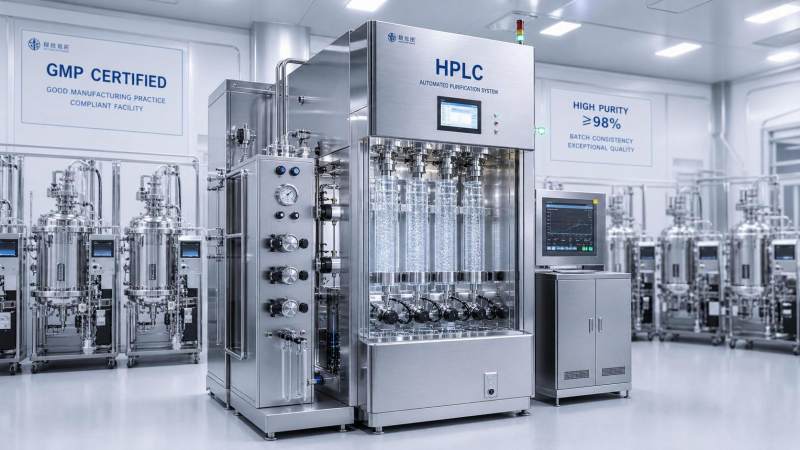
In the biotechnology and bio-active raw material sectors, the purity and batch-to-batch consistency of active peptides serve as the baseline for product safety and brand reputation. Impurities or inconsistent active concentrations can lead to reduced formulation efficacy or potential regulatory non-compliance.
High-tier peptide manufacturing plants leverage rigorous technical systems and quality controls to scale production while securing uncompromising product quality.
1. Advanced Purification Technology (Ensuring High Purity)
Crude peptides obtained directly from synthesis lines often contain truncated peptide impurities, residual reagents, and salts. To isolate target peptides, modern factories utilize preparative High-Performance Liquid Chromatography (HPLC).
By matching specific stationary phases and gradient elution mobile phases, factories precisely separate target peptide sequences from closely related impurities.
This process allows active cosmetic-grade or food-grade peptides to achieve stable purities exceeding 95% or 98%, while pharmaceutical-grade peptides can reach up to 99% purity.
2. Dual-Verification Analysis (No Room for Deviations)
Before any batch leaves the warehouse, it must pass a dual analytical test to confirm its chemical composition:
Mass Spectrometry (MS) for Identity: Verifies that the molecular weight perfectly aligns with the target sequence, ensuring correct peptide sequence synthesis.
HPLC for Purity: Measures the exact purity of the batch. Only batches showing single-peak dominance on analytical chromatograms are approved for the Certificate of Analysis (COA).
3. Automated Manufacturing & Standardization (Locking in Batch Consistency)
To eliminate human error—the primary cause of batch-to-batch variations—premium manufacturers implement fully standardized production flows:
Automated Solid-Phase Peptide Synthesis (SPPS): Computerized synthesis reactors manage washing cycles, reaction times, temperatures, and amino acid coupling speeds. This guarantees that batch $1$ matches batch $100$ in molecular structure and physical properties.
Strict Quality Management Systems: Production lines operate under globally recognized GMP (Good Manufacturing Practice), ISO 9001, or ISO 22000 certifications, implementing standardized batch records (SBR) for full process traceability.
4. Advertising & Compliance Guardrails (Google Ads Compliance)
When deploying organic SEO or paid search campaigns (like Google Ads) targeting global markets, ensure your messaging remains compliant with local advertising laws:
Focus on Industrial Precision: Highlight structural testing, chromatographic purities, manufacturing standards, and certified facilities.
Avoid Prohibited Claims: Do not use drug-like claims, such as treating clinical skin conditions (e.g., eczema, psoriasis) or curing physical disorders. Keep statements centered on functional benefits, stability, and cosmetic or nutritional formulation support.